




Digital Marketing vs Traditional Marketing in UAE

The media landscape in the United Arab Emirates does not move in increments. It shifts with seismic, uncompromising speed. For decades, the standard playbook for corporate visibility across the region was simple. You bought a massive billboard on Sheikh Zayed Road, booked a full page spread in Gulf News, or ran a prime time television spot during Ramadan. It was a game of raw financial muscle. The brand with the largest budget won the highest market share simply by yelling the loudest.
That era is over. Today, consumer attention is hyper-fragmented across mobile ecosystems, algorithmic feeds and conversational AI interfaces. The traditional vs digital marketing debate is no longer an academic discussion about preference. It is a stark dividing line between businesses that are capturing high value regional demand and those that are funding their own quiet obsolescence.
To win in the ultra competitive Gulf market, enterprise brands must thoroughly master the dynamics of digital marketing vs traditional marketing in UAE commerce.
Saturated Audiences and Accelerated Ad Spend (The Macro Shifts)
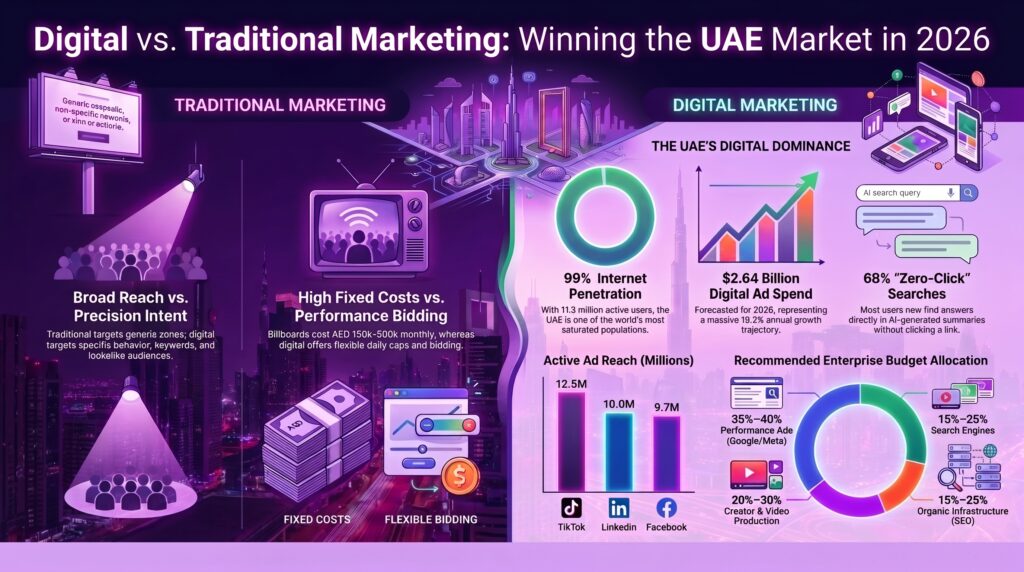
The UAE is currently home to one of the most digitally saturated consumer populations on earth. According to the comprehensive Digital 2026: UAE report by Meltwater and We Are Social, the country has achieved an astonishing 99% internet penetration rate, representing over 11.3 million active users. More importantly, the total number of registered social media user identities has scaled to 12.5 million, a figure equivalent to 110% of the actual population due to widespread multi-account usage across professional and personal networks.
This intense digital connection has altered corporate budgeting. Research from Statista and the IAB MENA Q1 Update indicates that UAE digital ad spend will reach a massive $2.64 billion, growing at an annual rate of 15.2%.
UAE Digital Ad Spend Growth Trajectory
├── 2025: $2.29 Billion Actual
├── 2026: $2.64 Billion Forecast (+15.2%)
└── 2029: $4.30 Billion Projected (17.7% CAGR)
The underlying data shows that this money is not flowing toward legacy media. Modern brands are investing heavily in performance channels like social video, retail media networks, and advanced automation.
Traditional Marketing vs Digital Marketing (The Fun Battle)
Evaluating traditional marketing vs. digital marketing requires assessing how consumer attention operates across the region. Traditional tactics treat the audience as a single monolithic block, assuming that every commuter driving past a billboard shares identical purchasing intent. Digital platforms flip this approach entirely, allowing brands to target users based on precise personal intent, active behavior, and historical interaction data.
|
Dimension |
Traditional Marketing |
Digital Marketing |
|
Targeting Precision |
Broad demographic and geographic zones |
High-intent keywords, behavior patterns, lookalikes |
|
Attribution Speed |
Brand-lift surveys over weeks or months |
Server-side tracking and data attribution in hours |
|
Operational Agility |
Fixed creative content; high change costs |
Hourly creative shifts and continuous asset updates |
|
Consumer Journey |
One-way messaging without direct feedback |
Interactive, real-time messaging and quick conversion |
|
Content Shelf Life |
The airtime slot finishes and the exposure ends |
Ranked evergreen content drives compounding value |
The primary difference lies in how fast a business can optimize its spending. In a traditional setup, if a major campaign underperforms, the capital is gone forever without protection. On digital channels, real-time bidding dashboards allow you to pause low-performing creative elements, realign budgets toward high-converting segments, and protect your margins within hours.
Cost of Digital Marketing vs Traditional Channels
Analyzing the actual cost of digital marketing vs traditional media reveals why capital is shifting so rapidly. Traditional media models require large upfront financial commitments. Booking a premium billboard on a main Dubai thoroughfare can cost between AED 150,000 and AED 500,000 per month, depending on location and lighting features. These arrangements require fixed term contracts and provide no guarantee of consumer engagement.
In contrast, digital marketing platforms operate on flexible, performance-driven pricing structures. Whether using cost-per-click models or cost-per-thousand impressions, enterprise brands can set precise daily spending caps. This setup allows startups and mid-market firms to compete effectively against larger organizations by focusing their capital exclusively on high-intent search terms and highly relevant audiences.
Enterprise Digital Budget Allocation
├── Performance Ads (Google/Meta) ──── [35% – 40%]
├── Organic Infrastructure (SEO) ───── [15% – 25%]
├── Creator & Video Production ─────── [20% – 30%]
└── Data Systems & Agency Operations ── [10% – 20%]
For most established B2B and consumer brands in the region, the typical standard guideline is to invest 7% to 15% of annual corporate revenue into digital marketing channels. Newer startups seeking aggressive growth often scale that investment to 15% to 25% to quickly build search visibility and capture early market share.
Why Digital Marketing Is Crucial Now and in the Future
The massive shift toward digital channels goes beyond simple media consumption habits. The fundamental mechanics of online discovery are undergoing a deep structural evolution, driven by artificial intelligence and changes in search behavior.
1- The Rise of Generative AI and Zero-Click Discovery
The traditional search engine results page is transforming rapidly. Industry data from SparkToro reveals that over 68% of Google searches now resolve without a single click, a trend accelerated by the rollout of advanced AI Overviews. Buyers are increasingly getting their answers directly from AI-generated summaries, bypassing standard website links entirely.
Because of this shift, standard search optimization is evolving into AI search optimization. Modern brands can no longer rely solely on legacy keyword placement. They must structure their data cleanly so that regional AI models cite their business directly inside conversational summaries. This approach helps protect organic traffic channels from sudden algorithmic drops.
2- The Power of Local Organic Visibility
Even with the rise of conversational AI assistants, maintaining a strong presence on traditional search networks remains essential for long-term customer acquisition. Incorporating expert SEO services UAE into your core marketing plan creates a highly resilient lead engine that drives sustainable organic traffic. High-ranking, educational content builds lasting brand authority without requiring continuous daily ad spend.
3- The Accuracy of Paid Media
When immediate visibility is required to launch a product or capture active seasonal demand, running targeted Pay per click in Dubai campaigns provides unmatched speed and market reach. By placing your brand directly in front of high-intent searchers at the exact moment they look for solutions, paid media bypasses long development timelines to deliver immediate pipeline opportunities.
The Expert Verdict: As legendary marketer Seth Godin famously noted, “Marketing is no longer about the stuff that you make, but about the stories you tell.” In the modern UAE market, the success of that story depends entirely on whether your delivery system can reach customers precisely when they are ready to buy.
Digital Marketing vs Traditional Marketing Statistics (Analyzing Regional Data)
The structural differences between traditional vs digital marketing are clearly visible in regional performance data. Across the GCC, consumers expect fast, frictionless, and personalized digital experiences.
- Audience Engagement: Modern short-form video now drives over 82% of total internet traffic. TikTok leads raw engagement metrics across the UAE with an active adult ad reach of 12.5 million users, outperforming legacy platforms like television and print.
- Conversion Optimization: Integrating direct messaging channels like WhatsApp Business APIs into paid social campaigns drops overall customer acquisition costs by up to 40% compared to traditional web forms.
- Operational Integration: Data from the HubSpot State of Marketing report reveals that 86.4% of marketing teams now use AI tools within their workflows to automate campaign scaling and personalize content libraries in real time.
UAE Social Network Active Ad Reach
├── TikTok ────────────────────────────── 12.5M
├── LinkedIn ──────────────────────────── 10.0M
├── Facebook ──────────────────────────── 9.7M
├── YouTube ───────────────────────────── 8.37M
└── Instagram ─────────────────────────── 8.05M
These statistics demonstrate that a brand’s actual digital presence is its most important business asset. Relying entirely on traditional vs. digital marketing frameworks that ignore real-time customer data makes it incredibly difficult to maintain a strong market position.
Blending Digital Strategy vs Traditional Assets (The Strategic Balance)
Emphasizing the undeniable advantage of digital vs traditional marketing does not mean traditional media has no place in a modern campaign. Instead, the default structural priority has inverted. Digital systems now serve as the core operational base, while traditional media acts as a selective amplifier for broad brand awareness.
An effective digital marketing strategy vs traditional plan uses physical assets to drive digital engagement. For example, a premium billboard or an exclusive event invitation should include clean digital entry points such as scannable visual codes or personalized web addresses. This approach moves offline audiences directly into your automated customer journeys.
Integrated Omnichannel Architecture
[Legacy Billboard / Event] ──(QR Code Sync)──> [Localized Landing Page]
│
(Automated Retargeting)
│
▼
[Paid Search & Email Nurture]
This cross-channel approach ensures that your offline marketing spend remains fully visible to your tracking systems. It connects initial brand exposure directly to measurable online conversion paths.
Choosing an Enterprise Growth Partner in the UAE
Navigating this complex, fast-moving digital ecosystem requires specialized technical expertise and deep local market insights. For enterprise brands looking to scale their operations, trying to manage complex technical SEO, multi-channel performance ads, and real-time data tracking in-house often strains internal resources.
Partnering with a specialized digital marketing agency in UAE allows your business to tap into advanced engineering talent, data experts, and strategic creative teams. The right agency partner helps modernize your entire marketing setup, moving your brand away from outdated traditional marketing vs digital assumptions. They replace guesswork with precise, transparent data systems built around measurable business growth.
Driving Lasting Expansion with Digital Gravity
The choice between marketing digital vs traditional is a defining strategic decision for your brand’s future growth. Relying on legacy media systems that lack real-time measurement options leaves your pipeline vulnerable to agile, data-driven competitors. To protect your market share, your brand must build an adaptive digital presence that actively captures consumer intent.
The elite creative and technical team at Digital Gravity Dubai specializes in building high-performing, measurable growth engines for prominent regional brands. By combining advanced AI search optimization with highly targeted paid media tactics and scalable organic campaigns, they ensure your business stays ahead of changing consumer behaviors. Drop the high maintenance legacy platforms and let Digital Gravity Dubai make you witness more successful journeys.