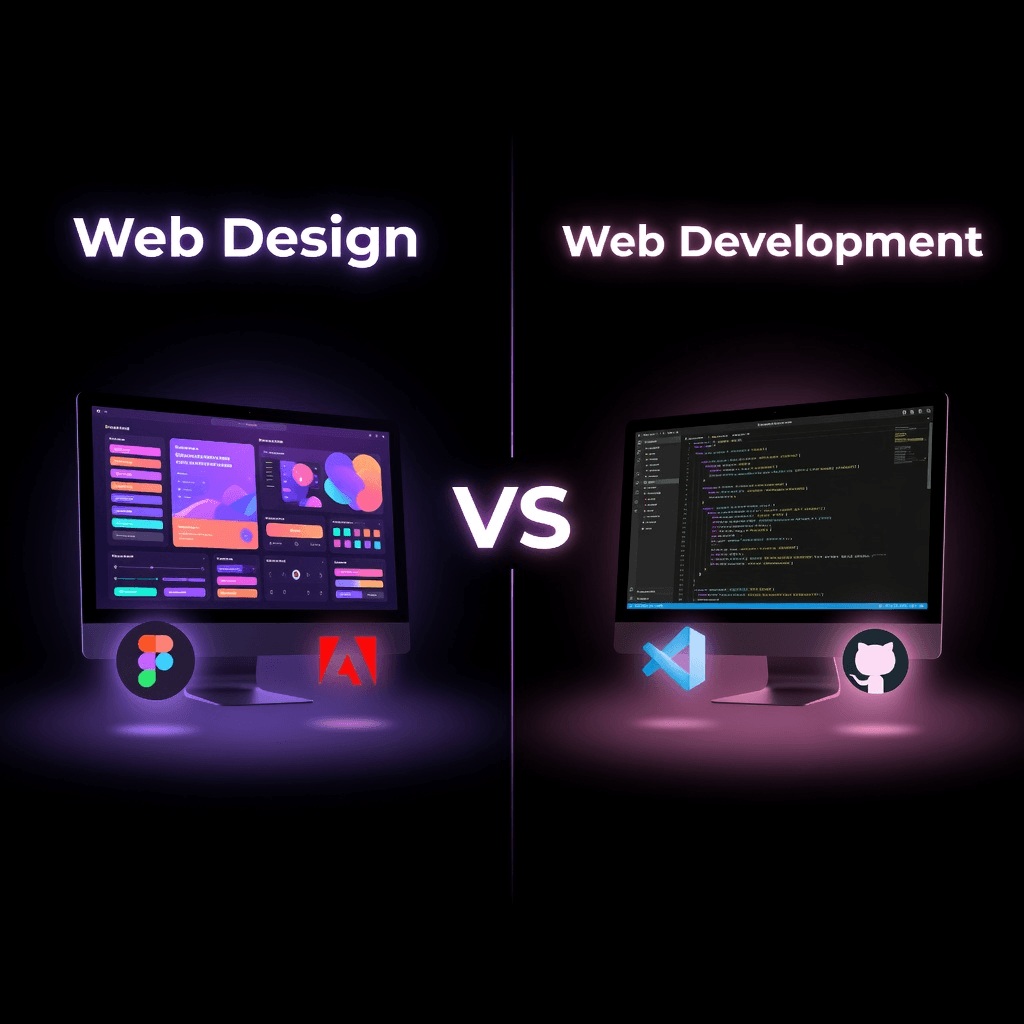





Custom Website Development vs. Templates: What’s Right for Your Dubai Business? [2026 Guide]

Launching a website in 2026 has never been easier. Building the right website, however, is a completely different challenge. Today, businesses in Dubai can choose between launching a template-based website in a weekend or investing in a fully customised digital platform built around their goals. Both options can work. The question is which one works for your business.
The timing of this decision matters more than ever. According to Statista, global eCommerce sales are expected to exceed $8 trillion by 2028, while Google’s Core Web Vitals continue to reward websites that load quickly, provide smooth user experiences, and remain technically sound. In other words, your website is no longer just a digital brochure. It is often your best salesperson.
As Steve Jobs famously said:
“Innovation distinguishes between a leader and a follower.”
The same applies to websites. A business that looks identical to hundreds of competitors rarely becomes memorable. If you’re comparing custom website development Dubai services with ready-made templates, this guide will help you make an informed decision based on budget, growth plans, branding, SEO, and long-term value.
One Website. Two Very Different Roads
Just suppose you’re opening a café in Downtown Dubai. You could rent a fully furnished space and open within days. Or you could design the entire space from scratch to reflect your brand, customer experience, and future expansion.
Both choices serve coffee. Only one creates a destination. That is essentially the difference between a custom website vs template website. A template offers speed and convenience. A custom website offers flexibility, scalability, and complete ownership of the experience. Neither option is automatically better. The best choice depends on your business goals rather than the latest design trend.
Custom Website Development vs. Templates: The Key Differences
A template website uses a pre-built layout that can be customized with your logo, colours, images, and content. Platforms like WordPress, Wix, Shopify, and Squarespace provide thousands of professionally designed templates that help businesses launch quickly.
Custom development starts with a blank canvas. Instead of adapting your business to fit a template, developers build the website around your processes, customer journey, and future growth plans. The difference becomes much clearer when compared side by side.
|
Template Website |
Custom Website |
|
Faster to launch |
Built from scratch |
|
Lower initial investment |
Higher upfront investment |
|
Limited flexibility |
Fully customised |
|
Shared layouts |
Unique branding |
|
Plugin-dependent |
Custom functionality |
|
Easier for small projects |
Better for long-term growth |
|
Limited scalability |
Highly scalable |
Think of templates as ready-made suits. They fit reasonably well. Custom websites are tailored suits. They are designed specifically for you.
Why More Dubai Businesses Are Choosing Custom Development
Dubai is one of the world’s most competitive digital markets and customers compare businesses within seconds. They expect fast loading pages, seamless mobile experiences, secure payments, multilingual support, and intuitive navigation. Meeting those expectations becomes harder when dozens of competitors use the same template.
This is one reason why demand for website design Dubai custom vs template solutions continues to grow across sectors such as healthcare, real estate, hospitality, finance, and eCommerce. A custom website allows businesses to build features that actually solve customer problems instead of working around template limitations.
For example, a Dubai-based property developer may need:
- Interactive property filters
- CRM integration
- Arabic and English content
- Appointment scheduling
- Live inventory updates
A standard template might support some of these features through plugins. A custom solution builds them directly into the platform, creating a smoother and more reliable experience.
As designer Don Norman once said:
“Good design is actually a lot harder to notice than poor design.”
When customers enjoy using your website without friction, they rarely think about the technology behind it. They simply trust your business more.
The Real Advantages of Website Templates
Templates deserve more credit than they often receive. Not every business needs enterprise-level development. If you’re launching a new startup, testing an idea, or creating a simple company website, a professionally designed template can be an excellent starting point. Modern website builders have become far more capable than they were just a few years ago. Many now include responsive layouts, SEO settings, security updates, and drag-and-drop editors that make content management straightforward.
Templates are particularly suitable when:
- Your budget is limited.
- You need to launch quickly.
- Your website has fewer than 20 pages.
- You don’t require complex integrations.
- Your branding requirements are relatively simple.
This is why many startups begin with templates before investing in a fully customised platform as the business grows. Launching quickly can sometimes be the smartest business decision. Perfection should never delay progress.
Where Template Websites Start Showing Their Limits
Templates solve today’s problems. Growing businesses need websites that solve tomorrow’s problems. As customer expectations increase, many businesses discover that adding new functionality becomes increasingly difficult.
- One plugin conflicts with another.
- Performance begins to slow.
- Design consistency starts breaking down.
- Maintenance becomes more complicated with every update.
This is where many businesses realise that the initial savings were only temporary. Some of the most common template website limitations include:
- Limited design flexibility
- Slower performance due to multiple plugins
- Difficult integrations with custom business systems
- Generic layouts that resemble competitor websites
- Reduced scalability as the business expands
A growing eCommerce business illustrates this perfectly. A fashion retailer might begin with 50 products on a template website. 12 months later, the catalogue could exceed 5,000 products, support multiple currencies, integrate with inventory software, and require personalised shopping experiences. What worked brilliantly during launch may now slow the business down. That’s not a flaw in templates. It’s simply a sign that the business has outgrown them.
Choosing Technology That Matches Your Growth
The biggest mistake isn’t choosing a template. The biggest mistake is choosing technology based only on today’s needs. Ask yourself one simple question:
Where do you expect your business to be in three years?
If the answer involves expansion, automation, custom customer experiences, or digital transformation, investing in a scalable website from the beginning often saves both time and money. The best websites don’t just support business growth. They quietly accelerate it.
Pros and Cons of Custom Website Development
A custom website is built specifically for your business. Every page, feature, workflow, and user journey is designed around your goals instead of adapting your business to fit someone else’s template.
It requires a bigger investment upfront. In return, you gain flexibility, stronger branding, better performance, and room to grow. Think of it this way: buying a template is like renting a furnished apartment. Building a custom website is like designing your own home.
As the legendary designer Dieter Rams famously expressed through his principles of good design:
“Good design makes a product useful. It emphasizes the usefulness of a product whilst disregarding anything that could possibly detract from it.” That principle perfectly describes custom development.
|
Pros |
Cons |
|
Completely unique design tailored to your brand |
Higher upfront investment |
|
Better SEO structure and technical optimisation |
Longer planning and development time |
|
Faster performance with clean code |
Requires experienced designers and developers |
|
Easy to scale as your business grows |
Ongoing maintenance and updates are essential |
| Custom integrations with CRM, ERP, payment gateways, and APIs | Not ideal for businesses needing an immediate launch |
|
Greater security and flexibility |
Initial project scope requires more planning |
The Biggest Advantages Of Custom Websites You Need to Know
A custom website gives businesses complete ownership over the customer experience. Instead of selecting from preset layouts, your business controls every interaction. Navigation becomes simpler. Checkout becomes faster. Landing pages become conversion-focused.
Key benefits include:
- Complete design freedom
- Better page speed optimisation
- Easier SEO implementation
- Stronger security
- Better scalability
- Custom integrations with CRM, ERP, booking systems, or payment platforms
- Easier feature expansion as the business grows
For example, imagine a Dubai real estate agency. A template might display listings perfectly well. A custom platform can automatically recommend properties based on user behaviour, schedule viewings, integrate WhatsApp conversations, calculate mortgages, and connect directly with the company’s CRM. That difference directly impacts revenue.
The Trade-Offs
Custom development is not the right solution for everyone. Businesses should also understand its limitations before investing. Some considerations include:
- Higher initial investment
- Longer development timeline
- Requires experienced developers
- Ongoing maintenance becomes more important
These are not disadvantages for every business. They simply mean custom development is designed for companies planning long-term growth rather than quick launches.
Custom vs Template Website Cost Comparison in Dubai
Price is often the first question business owners ask. It should probably be the second. The first question should be:
“What return will this website generate over the next three years?”
A cheaper website that never produces leads quickly becomes an expensive option. Below is a general comparison for 2026.
|
Website Type |
Typical Investment |
Best For |
|
DIY Website Builder |
AED 500–2,000/year |
Personal projects |
|
Premium Template Website |
AED 3,000–10,000 |
Small businesses |
|
Semi-Custom Website |
AED 10,000–25,000 |
Growing SMEs |
|
Fully Custom Business Website |
AED 25,000–80,000+ |
Established companies |
|
Enterprise Web Platform |
AED 80,000+ |
Large Organisations |
The custom website development cost Dubai businesses pay depends on several factors:
- Number of pages
- Custom functionality
- Third-party integrations
- UI/UX complexity
- CMS requirements
- SEO implementation
- Security requirements
- Performance optimisation
Many companies focus only on launch costs. Experienced businesses evaluate ownership costs over several years instead.
Which Option Wins for SEO and Website Performance?
Google rewards websites that provide fast, helpful, and reliable user experiences. That is why website architecture matters as much as keywords. According to Google’s research on page experience, even small improvements in loading speed can improve user satisfaction and reduce abandonment. Core Web Vitals also remain an important quality signal for modern websites.
Templates can certainly rank. Many businesses achieve excellent SEO results using well-built themes. The challenge appears when businesses begin adding multiple plugins, unnecessary scripts, and heavy visual elements. Performance often suffers.
Custom websites remove that unnecessary weight. Everything is built only for the features the business actually needs. This usually provides advantages such as:
- Faster loading pages
- Cleaner code structure
- Better Core Web Vitals
- Easier schema implementation
- Improved crawlability
- Better mobile performance
- Higher conversion rates
That does not mean templates cannot rank. It simply means custom websites provide developers with greater control over technical SEO. For businesses investing heavily in organic traffic, the long-term SEO benefits of custom website development are often significant. As search continues moving towards AI-generated results and answer engines, technical quality is becoming even more valuable.
When Should a Dubai Business Choose a Custom Website?
Not every company needs one immediately. But many eventually outgrow templates. A custom website becomes a smarter investment when your website is expected to become a business asset rather than an online brochure.
- You should consider custom development if:
- Your business generates leads online
- Branding differentiates you from competitors
- Customer journeys are unique
- You require advanced integrations
- You expect rapid growth
- Website performance directly affects revenue
- You need multilingual functionality
- Security and compliance are priorities
Consider an expanding healthcare provider in Dubai. Patients need appointment booking. Doctors require separate dashboards. Insurance verification must happen automatically. Medical records connect with secure databases. Templates rarely handle these workflows efficiently. Custom development solves them naturally. This is exactly why many businesses investing in custom website for small business Dubai eventually transition toward fully tailored platforms as they grow.
When Are Templates Actually the Better Choice?
Templates often receive unfair criticism. In reality, they solve many business problems extremely well. A template is an excellent choice when speed matters more than complexity.
Examples include:
- Startup landing pages
- Event websites
- Portfolio websites
- MVP launches
- Small brochure websites
- Short-term marketing campaigns
If your objective is validating an idea before making a large investment, templates offer tremendous value.
As entrepreneur Reid Hoffman once said:
“If you’re not embarrassed by the first version of your product, you’ve launched too late.”
That thinking applies perfectly to websites. Sometimes launching quickly is smarter than waiting six months for perfection. The important point is recognising when your business has outgrown the template.
How Digital Gravity Helps Businesses Choose the Right Solution
Every business has different objectives. Some need speed. Others need flexibility. Some require enterprise integrations from day one. That is why experienced agencies begin with strategy instead of software. Rather than recommending one solution for everyone, Digital Gravity web design services evaluate business goals, customer journeys, technical requirements, scalability, and budget before suggesting the most suitable approach. For businesses needing advanced content management, the team also delivers CMS development Dubai solutions tailored to operational workflows.
Companies looking for flexible publishing capabilities often choose WordPress development Dubai, while larger organisations may benefit from fully customised platforms designed around complex business processes. Retail brands planning to scale online can also leverage ecommerce website development Dubai solutions that support custom checkout experiences, inventory integrations, payment gateways, and long-term growth. The objective is simple. Build the website your business actually needs today while ensuring it can support where you want to be tomorrow.
Frequently Asked Questions
Should I choose a custom website or a template for my Dubai business?
It depends on your business goals. Templates work well for startups and smaller websites, while custom websites are better for businesses that need stronger branding, advanced functionality, better scalability, and long-term digital growth.
What’s the difference between a custom website and a template website?
A template website uses pre-built layouts and limited customisation. A custom website is designed and developed specifically for your business, giving you complete control over design, functionality, integrations, and user experience.
Is a custom website more expensive than a template website?
Yes. Custom websites require more planning, design, and development work. However, they often deliver a better long-term return by improving SEO, conversions, scalability, and overall business performance.
What are the pros and cons of using a website template?
Templates are affordable, quick to launch, and easy to manage. Their limitations include restricted flexibility, slower performance when overloaded with plugins, and difficulty creating a truly unique brand experience.
Which is better for SEO: custom website or template?
Both can rank well if built correctly. However, custom websites usually provide better technical SEO, faster performance, cleaner code, and greater flexibility for long-term optimisation.
How much does custom website development cost in Dubai?
Costs vary depending on features, integrations, and complexity. In 2026, most professional custom business websites in Dubai typically range from around AED 25,000 to AED 80,000 or more for enterprise-level projects.
Do small businesses in Dubai need a custom website?
Not always. Many small businesses can successfully launch with a high-quality template. As the business grows and requires unique functionality or stronger branding, moving to a custom website often becomes the better investment.
What factors should I consider when choosing between custom and template websites?
Evaluate your budget, timeline, branding needs, future growth plans, required integrations, SEO goals, and expected website traffic. The right choice depends on where your business is today and where you expect it to be over the next few years.